 findclout.com
App User Acquisition Playbook for 2026
Worldwide app user-acquisition spending reached approximately $78 billion in 2025, up 13% year over year, according to AppsFlyer. Its analysis also puts iOS spending growth at 35%, with Android flat, declining about 1%, and non-gaming spending at $53 billion against gaming's $25 billion. App marketers aren't competing only with games anymore. They're bidding against finance, ecommerce, travel, and other consumer apps for attention that still has to become profitable usage.
For an American acquisition campaign, cheap reach isn't the objective. Verified US attention, retained users, and post-install payback are. Per-post brand-safety review is the control that keeps an inexpensive distribution channel from becoming an expensive reputation problem.
Table of Contents
- App User Acquisition Costs by Channel
- Measure Payback When Attribution Breaks
- How to Run the Acquisition Loop
- Creative Formats That Earn the Install
- Review Every Post for Brand Safety
- Launch a Verified-View Pilot
App User Acquisition Costs by Channel
The market's scale makes channel selection a portfolio decision, not a search for the lowest headline price. An install campaign purchases a different outcome from a creator placement, and neither becomes valuable until the right American user completes a meaningful action.
What each app user acquisition channel buys
| Channel | What you buy | Price signal | US audience control | Best job |
|---|---|---|---|---|
| Paid social on Meta and TikTok | Install or click | US CPI often several dollars and still rising | Country targeting, mixed view quality | Scale only after onboarding converts |
| Apple Search Ads | High-intent install | Premium CPI on brand and category terms | Strong US App Store traffic | Capture people already searching |
| Google app campaigns | Mixed install | Mid-range CPI with opaque placement | Geo settings available | Volume once creative and onboarding work |
| One-off influencer posts | A single negotiated post | Custom fee, days or weeks to place | Weak proof the audience is American | Small tests only |
| Vetted creator-page network | Verified views | Format-based CPM, with sports or finance product placement capped at $0.25 CPM | US geo filters and per-post review | Cheap American attention at scale |
Treat the platform price descriptions as buying signals, not a forecast for your account. Your category, optimization event, creative, and audience restrictions determine what you can purchase. A search campaign may look expensive beside feed distribution while producing a much stronger activated cohort.
Buy intent and attention for different jobs
Apple Search Ads captures people expressing demand in the storefront. Protect the distinction between branded searches and category discovery, because buying someone already searching your name isn't the same as creating a new customer.
Meta and TikTok give you creative-led discovery and conversion optimization. They're useful when the app's promise is easy to demonstrate, but skipped ads and weak onboarding can turn a plausible media plan into wasted spend. Don't increase bids to compensate for an offer users don't understand.
Google app campaigns can add volume once your events and assets are reliable. Their automated delivery also makes placement-level interpretation less straightforward than a tightly controlled search campaign.
Creator distribution purchases attention before explicit intent. One-off deals leave the buyer coordinating captions, audience evidence, disclosure, and reporting separately. A vetted network centralizes that work, but the buyer should still distinguish verified views from unique people, qualified visits, and activated users.
Set the audience before setting the budget
Start with the job your best American customer needs done. SubmitMySaas's guide can help you define your ideal customer profile before you translate that profile into page categories, exclusions, and an activation event.
For a sports or finance product, our vertical product placement has a $0.25 CPM ceiling and is scoped to one vertical. That scope matters: a finance placement shouldn't become a broad entertainment buy just because another page has cheaper inventory.
Buying rule: Fund an intent channel and a verified-view channel, then compare the retained US users each produces. Don't mistake a cheaper media unit for a cheaper customer.
Measure Payback When Attribution Breaks
Only 18% of more than 700 marketing and product executives were very confident they could accurately attribute installs, while 74% said privacy regulations create costly measurement blind spots, according to the mobile marketing study announced through PR Newswire. That's an operating condition, not a reason to stop making decisions.
Use a decision table that separates what you bought from what users did afterward. A dashboard can inform the decision without becoming the sole authority.
Signals that replace a last-click CPI decision
| Signal | Question it answers | Budget rule |
|---|---|---|
| CPI | What did the install cost? | Never the only reason to scale |
| Verified-view CPM | What did measured American attention cost? | Scale only while CPM stays under the format ceiling and payback holds |
| Activation rate | Did the user finish onboarding or a first transaction? | Primary quality gate for creator traffic |
| Early LTV or payback | Does revenue cover cost inside the payback window? | Keep the channel only if incremental payback holds |
| US audience share | Were the viewers in the United States? | Pause pages that leak outside the bought geography |
| Holdout or geo lift | Did the burst create users you would not have had? | Required when branded search also moves |
Reconcile signals instead of choosing a favorite
For iOS, build a compact, ordered conversion-value framework: install, onboarding completion, registration, first transaction, and revenue band. Keep it coarse enough to avoid fragmenting reporting into cells too sparse to interpret.
Apple's SKAdNetwork documentation explains that postbacks exclude user- or device-specific data and are cryptographically signed. Reconcile those postbacks with consented first-party events and cohort outcomes, allowing for delayed reporting and revenue that arrives outside the measurement window.
Maintain a separate Android measurement path with documented event mappings. The business meaning of activation should remain consistent, even when the platform's reporting mechanics differ.
For creator campaigns, our view measurement may use automated scraping, manual proof submission, or both, and we choose the method. Keep that delivery evidence separate from your app analytics: proof that a post received views doesn't prove those viewers became incremental customers.
Make uncertainty actionable
When a creator burst coincides with increased branded search, use a suitable geographic or audience holdout. Compare exposed and unexposed groups while accounting for other promotions, product changes, and seasonal demand. Don't assign every unexplained organic install to the campaign.
Use revid.ai's guidance to measure how your content performs when organizing creative-level reporting. For the app-specific handoff, our guide to attributing app installs from organic TikTok helps frame the gap between social discovery and installation.
Write down the payback window, acceptable US audience share, and activation floor before launch. If the observed cohort misses a hard requirement, pause expansion rather than adjusting the requirement to make the campaign look successful.
How to Run the Acquisition Loop
Run the loop before adding more channels. Otherwise, each additional source introduces another explanation for results you can't confidently interpret.
Use this sequence to establish the campaign's operating boundaries.
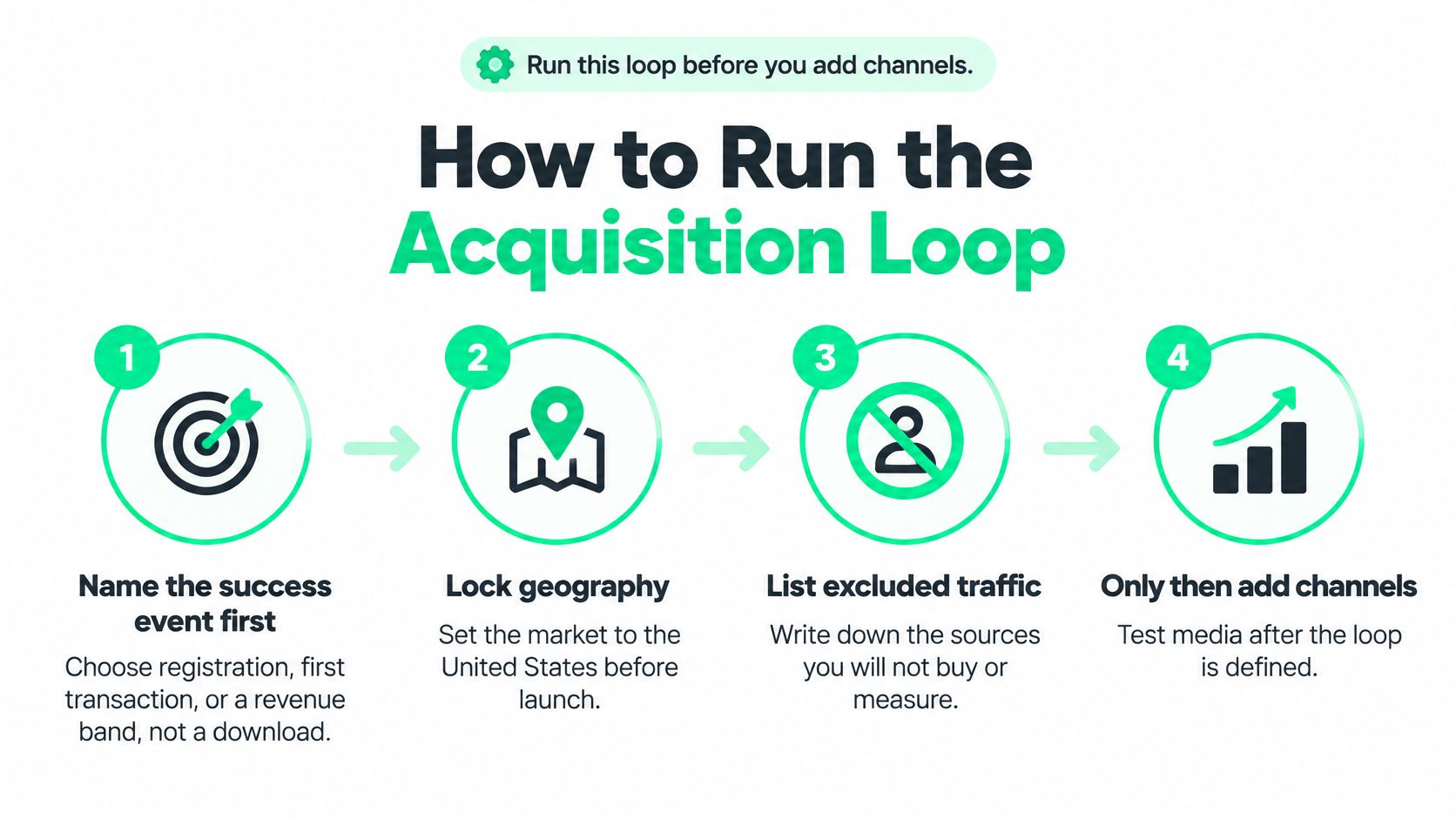
Define the experiment before buying traffic
Name the success event first. Choose registration, first transaction, or a revenue band based on how the app creates value. Confirm that the event fires correctly in your product analytics and mobile measurement partner. If you optimize only for downloads, the buying system can succeed while the business fails.
Lock geography and exclusions. Set the market to the United States and document prohibited topics, unsuitable sources, and category-specific restrictions. Tier-1 targeting isn't a substitute for an explicit American audience requirement. Without written boundaries, buyers and creators can interpret audience fit differently.
Choose the channel pair and cap exposure. Combine an intent channel with verified-view distribution, with a spend limit your team can tolerate if the experiment fails. Keep the offer stable enough to compare cohorts. Changing the channel, incentive, and onboarding simultaneously leaves you without a useful diagnosis.
Make the promise survive the tap. Use the same offer in the meme or video, landing experience, store assets, and first relevant in-app screen. Configure deep links and an appropriate fallback for people who haven't installed. A clever post that leads to a generic welcome screen creates avoidable friction.
Read behavior before releasing more budget
Ship a short burst and inspect engagement. Read return behavior and session quality alongside installs. As category context, Adjust's Mobile App Trends report puts marketplace apps at 24.8% day-one retention and 10.69-minute average sessions in the first half of 2025, while banking apps reached 20.6% day-one retention. These aren't universal targets: a banking task and a marketplace browsing session serve different purposes.
Stop the wrong placements immediately. A post that misses the geography requirement, obscures sponsorship, or attracts an unsuitable cohort shouldn't remain active merely because its engagement looks strong. Separate a distribution failure from an onboarding failure before replacing creative. For community-led expansion, Bazzly's Reddit marketing guide provides useful context on adapting to community expectations rather than copying feed content into every environment.
Reallocate to the cohort that pays back. Use a 7 to 21 day campaign wrap to review delivery and early behavior, while continuing revenue observation for your chosen payback window. Move budget toward the qualifying cohort and rerun the experiment with a controlled change. Don't declare lifetime profitability from an early delivery report.
Give one person ownership of the next-budget decision. Product should explain onboarding losses, the media buyer should explain delivery, and analytics should explain uncertainty, but someone must resolve the trade-off.
The metric allowed to release the next dollar is incremental cohort payback, subject to American audience and brand-safety gates. Views and installs explain the route; they don't approve the spend.
Creative Formats That Earn the Install
Channels determine where you buy distribution. Formats determine how the offer earns attention. Choose the creative's job before asking a creator to make it entertaining.
A native placement should fit the surrounding feed without concealing its commercial nature.
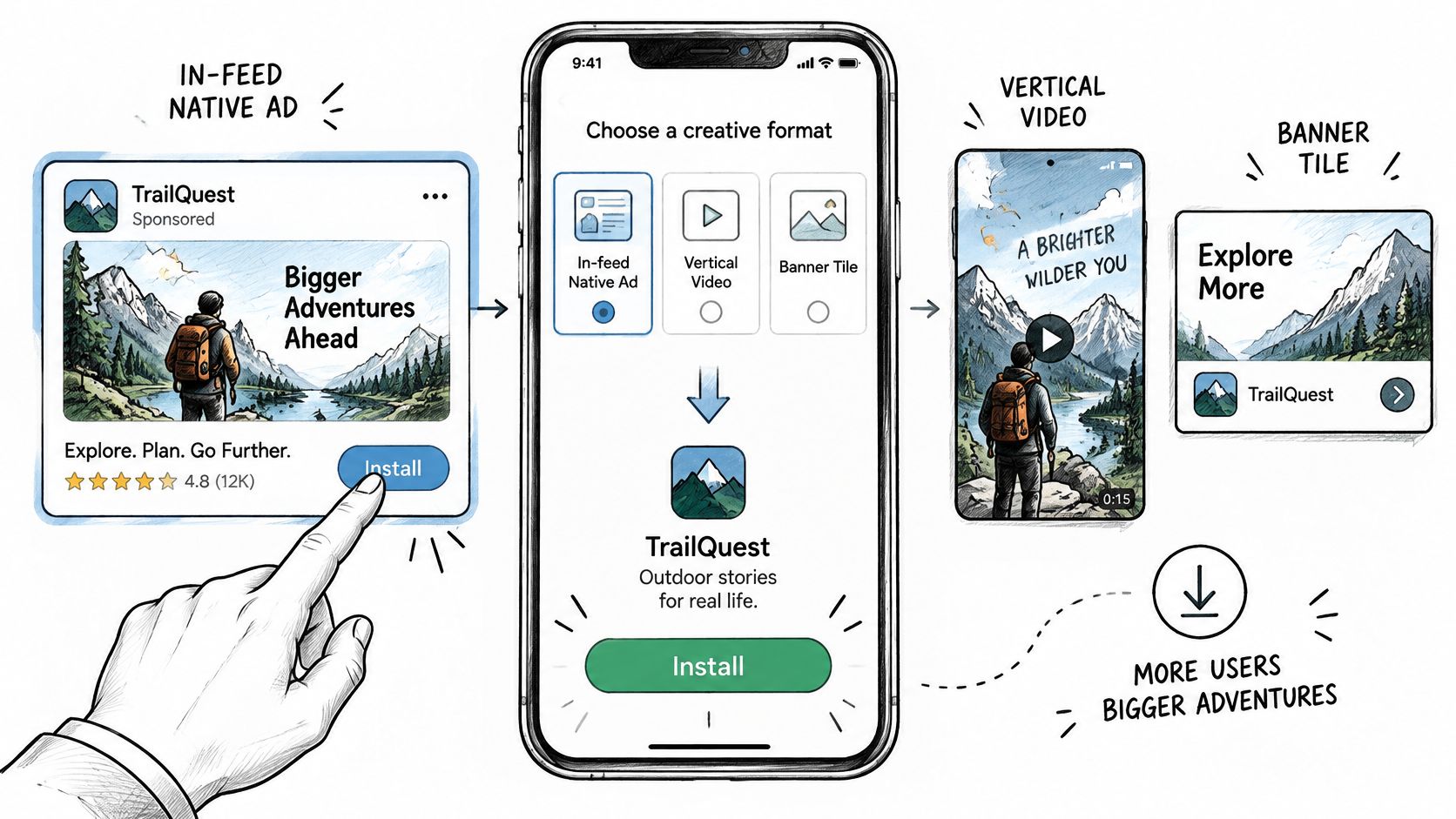
Creative formats by job and price
| Format | Job | Price signal | Use when |
|---|---|---|---|
| Logo and caption on existing clip | Awareness inside culture | $0.20 CPM | Offer is simple and the feed is moving |
| Vertical sports or finance placement | Niche fit with keyword rules | $0.25 CPM ceiling | Audience must match a category |
| Branded meme or video variation | Product demo or joke | $1.50 to $3.00 CPM | Product action is visual or the joke carries the claim |
Match the format to the explanation required
Logo and caption distribution works best when the audience can understand the offer without a tutorial. Use an approved caption with a clear reason to investigate the app. Don't expect a watermark alone to explain an unfamiliar product.
A vertical placement adds contextual discipline. Required keywords and exclusions help keep the campaign inside the intended sports or finance conversation. Category relevance still needs American audience evidence, authentic engagement, and suitable surrounding content.
Branded meme or video variations give you more room to explain. Use video for a visible action, such as a wallet transfer or an AI result. Use caption variations when the joke or observation carries the product promise without interrupting the feed.
For sports inventory, Nielsen reported 46 billion minutes of US women's sports consumption during 2025. That establishes the scale of attention in a relevant American environment, not evidence that sports viewers will install your app. Test the offer and cohort rather than treating fandom as purchase intent.
Use the embedded video as a creative reference, then evaluate your own assets against the product action they need to communicate.
Keep the claim intact through onboarding
Apply a single creative-matching rule: the first relevant in-app screen must fulfill the promise made in the post. If a caption promotes a specific tool, show that tool rather than an unrelated subscription pitch. If availability or eligibility is restricted, don't omit that restriction for a cleaner joke.
Keep successful hooks recognizable in storefront assets. Our guide to building an App Store preview video from UGC clips offers a practical way to carry creator-led material into the install decision.
Evaluate variations by activated cohorts, not by which joke attracts the loudest comment section. Entertainment can earn attention without earning product interest.
Review Every Post for Brand Safety
The FTC's native advertising guide says the commercial nature of promotional content must be clear and prominent, with unambiguous disclosures close to the relevant content, readable against the background, and visible long enough to understand. Review the exact post viewers will receive, not an account's general description.
The FTC's influencer disclosure guidance treats payment and other material connections as relationships requiring disclosure with the endorsement itself. A profile biography, obscure link, or ambiguous hashtag isn't a substitute for a clear post-level disclosure.
Reject unsuitable submissions before publication
Use the following as an operating checklist, with a documented decision for every submission:
- Missing or illegible disclosure: Reject captions, overlays, or video treatments that conceal sponsorship, blend into the background, or disappear before viewers can read them.
- Off-geo audience: Reject pages that can't substantiate the American audience standard purchased for the campaign.
- Prohibited topic: Reject content that violates the advertiser's exclusions, even if the creator expects strong engagement.
- Unverifiable views: Hold delivery credit when the evidence doesn't support the claimed count.
- Implied independence: Rewrite content that presents a paid recommendation as an ordinary fan's unsolicited opinion.
Our creators submit screen recordings and screenshots of audience-analytics dashboards, such as Instagram audience insights. Review that evidence before approval rather than inferring geography from an English caption, an American team logo, or a familiar creator handle.
The FTC's Lord & Taylor enforcement discussion illustrates the risk of presenting paid endorsers as independent users. The operational response is enforceable submission rules, not a disclosure reminder buried in onboarding.
Build real-time review into distribution
Our workflow combines AI scoring with human review before posting, and nothing goes live without brand sign-off. Every submission should be checked against the approved caption, watermark treatment, disclosure, prohibited topics, audience-quality standard, and US geo requirement. The AI scoring system supports that screening rather than replacing accountable approval.
Keep an audit record containing the creator handle, submitted asset, approved caption, disclosure, audience evidence, reviewer, timestamp, and decision. Preserve the published version too, so a later edit can be identified. If a placement fails, remove or correct that handle's content without unnecessarily stopping compliant placements.
Control before scale: Real-time review means making fast, recorded decisions about every submission. It doesn't mean allowing questionable posts to run while someone catches up.
This attention to detail is how a distribution operation can scale toward billions of views while protecting the brand and maintaining high-quality geography. Broad reach isn't a defense for a misleading post, and a strong American audience doesn't excuse an unsafe claim. Both requirements must hold.
Launch a Verified-View Pilot
Decide with a bounded pilot, not a vendor presentation. If the immediate need is category demand capture, keep Apple Search Ads or Google app campaigns focused on the conversion event your economics support. If the need is American feed attention, test verified-view distribution without pretending that delivery guarantees also guarantee customers.
At FindClout, a brand supplies its budget and goal, whether reach, sign-ups, or a launch moment, and we return a plan with a guaranteed view number. The first campaign costs $20,000 to $30,000, guarantees 100 million views, and is billed as one flat invoice.
Put the commercial and measurement terms together
A useful pilot agreement connects the purchased media to the evidence and operating rules needed to assess it. Keep these items in the campaign record:
- Delivery commitment: Record the purchased view total, eligible formats, and qualifying-post requirements.
- Counting method: Document how views are measured and what evidence supports delivery credit.
- Audience standard: Attach the American geography requirement and the audience evidence for approved pages.
- Publication controls: Specify the disclosure, exclusions, and sign-off process before creators publish.
- Remediation: Distinguish an underperforming post from an ineligible or noncompliant placement.
- Invoice scope: Keep the quoted media, production, and service terms together so your comparison reflects the actual purchase.
If a post underperforms, we run more posts until the purchased view number is hit. That is a delivery remedy, not a promise of a particular activation rate or revenue outcome. Any refund, unused-view, or fee treatment beyond the quoted agreement should be explicitly resolved before booking rather than assumed.
Separate delivery acceptance from growth approval
The media team can accept verified delivery while the growth team continues evaluating the cohort. Those decisions answer different questions. A campaign may fulfill its view commitment without earning additional acquisition budget.
Use the pilot to identify which handles, contexts, and creative promises produce qualified American users. A page with fewer views but stronger activated users may deserve a larger allocation than a page with impressive reach and weak downstream behavior.
Don't commit the next tranche because the campaign delivered quickly. Expand only when the agreed US audience standard, disclosure requirements, and early cohort economics qualify. If delivery is sound but onboarding loses users, fix the handoff before purchasing another burst.
The practical advantage of centralized creator distribution is operational control: coordinated submissions, consistent evidence, and the ability to intervene at the placement level. Keep that discipline as spend grows. Cheap views are worthless to this acquisition plan unless they reach Americans through disclosed, brand-safe content and produce users who stay.
FindClout offers verified-view creator distribution for app marketers who need American attention with per-post brand controls. Visit FindClout with your budget, target audience, activation event, and excluded topics to build a pilot you can judge on delivery quality and post-install payback.
Want this audience for your brand?
FindClout puts your brand in front of verified American audiences across every major US page — brand-safe, at scale.
Start Your Campaign