 findclout.com
Ambassador Programs for Small Influencers That Scale
Small influencer ambassador programs usually fail for a simple reason, they're treated like a creator relationship problem when they're really a routing problem. The moment you need tier 1 U.S. audiences, visible brand safety, and repeatable delivery at scale, a spreadsheet and a DM thread stop being an operating system and start being a liability. Research on creator performance also shows why the old “bigger is better” instinct breaks, because engagement generally declines as audience size rises, with one benchmark reporting 3.86% average Instagram engagement for micro-influencers versus 1.21% for mega-influencers, and another citing 1.68% for accounts with 10,000 to 100,000 followers, 1.12% for 100,000 to 1 million, and 0.96% above 1 million. (micro-influencer benchmark)
Table of Contents
- Why Most Ambassador Programs Stall at Small Influencer Scale
- Designing the Program Before You Recruit a Single Creator
- Compensation Models That Actually Work for Small Creators
- Recruiting, Onboarding, and Real-Time Submission Review
- Brand Safety and US Audience Verification as a System, Not a Checkbox
- Tracking Performance and Preventing Ambassador Roster Fatigue
- Scaling a Small-Influencer Program From Pilot to Billion-View Reach
Why Most Ambassador Programs Stall at Small Influencer Scale
Manual ambassador hunting is a craft. It does not scale. Brands start with a few energetic creators, then pile on more names, more DMs, more exceptions, and more approvals until nobody can tell which pages are moving qualified attention.
The four failure modes that sink the roster
The first failure is recruitment by hand. Someone on the team spends all day chasing creators, then loses control of fit because the pipeline is always behind the workload. The second failure is unverified views, which means the dashboard looks healthy while the audience quality is fuzzy or outright bad.
The third failure is off-brand content going live because nobody owns final review. The fourth is roster fatigue, where the program has dozens of “ambassadors” who rarely post, rarely respond, and steadily drain attention from the few creators who still care.
Practical rule: If you can't review every submission before it goes live, you don't have a program, you have a wish list.
That's why ambassador programs for small influencers should be built like infrastructure, not like a one-off campaign. The historical shift in creator marketing has been from isolated celebrity endorsements to distributed creator programs, and that shift only works when the brand has centralized coordination, standardized rules, fraud screening, and measurement across many pages. The economic logic is simple, multiple smaller creators give you more test surface across audiences, messages, and geographies than one high-reach placement.
For brands focused on American markets, this matters even more. Niche U.S. communities in sports, gaming, finance, and consumer technology are large enough to support specialized creator cohorts, but only if the system filters for geography, content fit, and compliance before anything ships.
Designing the Program Before You Recruit a Single Creator
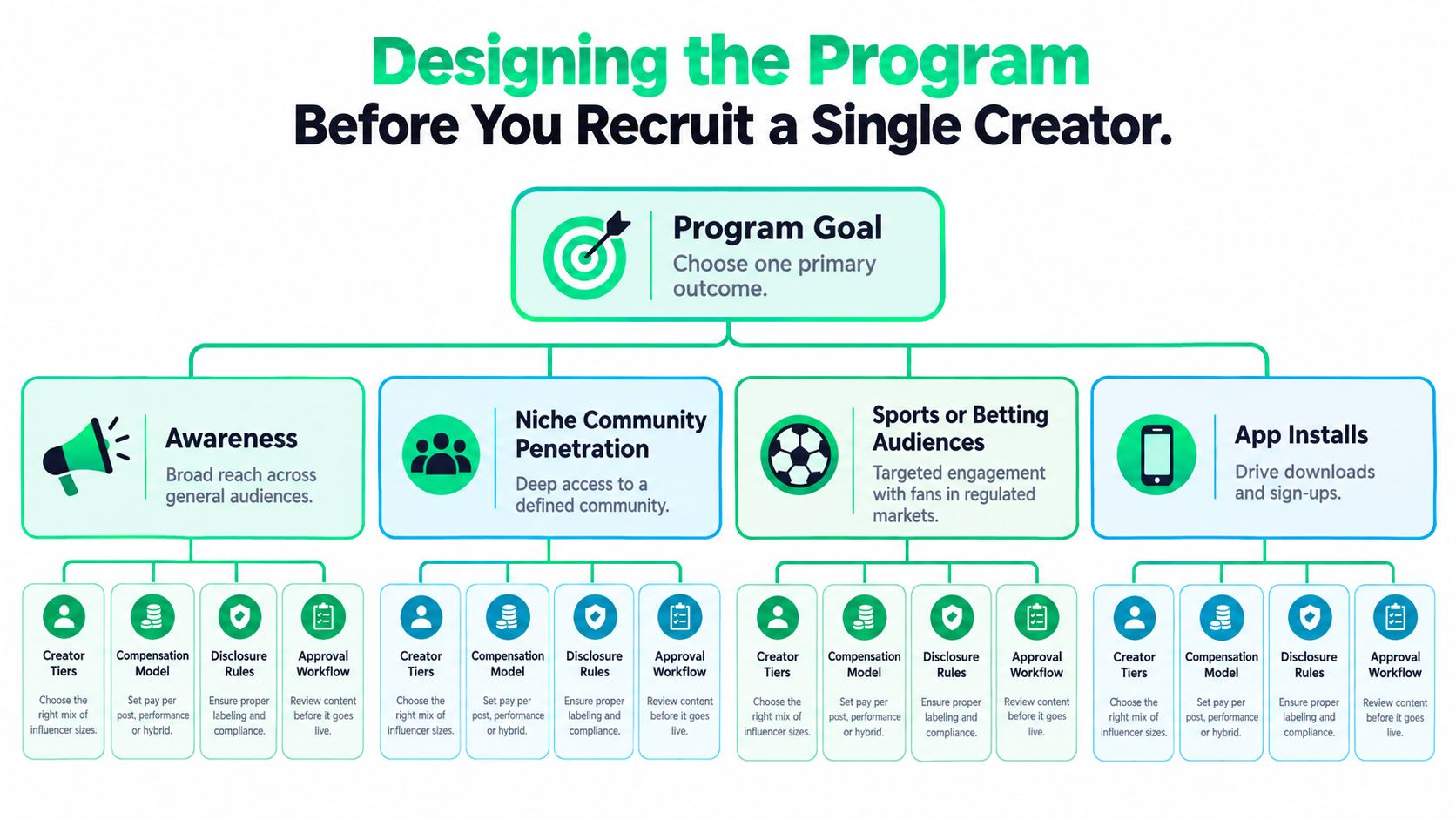
Start with one primary outcome. If you try to chase awareness, installs, community, and sales in the same pilot, your recruitment criteria will drift and your approval standards will get sloppy. Pick the job the program has to do, then design around that job.
Lock the audience, the rules, and the no-go list
For U.S.-first programs, the audience filter comes first. Decide what counts as a qualifying page, what niches matter, and what you will refuse to publish, because a creator who looks good on paper can still be wrong for the market you need.
A clean program spec should define creator tiers, compensation model, disclosure rules, and approval workflow before outreach starts. It should also spell out whether the brand wants broad awareness, niche penetration, sports or betting audiences, or app installs, because each of those goals changes how you vet pages and what you tolerate in content.
Use the brief as your source of truth, not your memory. If a creator asks for an exception, the answer should come from the spec, not from whoever happens to be online that day. For planning discipline, a practical reference is plan campaigns that ship, because a program fails fast when the team improvises the rules after recruitment has already begun.
The same document should connect to your operating stack, including your content creator program workflow. That keeps design, recruiting, review, and reporting anchored to one written standard instead of scattered across chat threads.
Write this down before recruitment starts: who qualifies, what's off-limits, how disclosure must appear, and who has final approval.
Build the one-page spec
The page doesn't need to be ornate. It needs to answer five questions with no ambiguity.
- What is the primary goal? Awareness, installs, niche reach, or repeat promotion.
- Who qualifies? U.S. audience, niche relevance, acceptable content history, and creator tier.
- What gets rejected? Hidden disclosures, prohibited claims, wrong geography, and off-brand tone.
- How do creators get paid? Flat, product, commission, or hybrid.
- Who approves? A named reviewer with the authority to stop a post.
Once that exists, recruiting gets easier because every candidate is measured against the same standard. Without it, the team ends up approving bad fits just to keep the roster warm.
Compensation Models That Actually Work for Small Creators
Small creators need a deal they can understand fast. If the offer feels vague, they assume the brand is shifting risk onto them, and participation drops.
Start with the payment structure that matches the job.
Flat fees work when you are buying labor and usage rights. They break down fast when brands pretend they are performance incentives, because small accounts often have noisy attribution and limited conversion volume. Product-only deals can work for genuine fans, but they place too much risk on the creator if the brand expects original content, repeat posting, or a real content commitment. Commission-only deals get messy when the creator is asked for originality, paid-media rights, or exclusivity, because the brand is asking for deliverables without paying enough upfront.
Hybrid models make the most sense for ambassador programs for small influencers. Pay for labor and usage rights first, then add performance upside through unique codes, attribution windows, refund treatment, and bonus thresholds. That split keeps the creator from turning into an unpaid acquisition channel. It also gives the brand a cleaner way to control cost and reward real results.
Performance-only deals are getting harder to sell to creators, not easier. Marketers already rank finding the right creator as a leading challenge for 43.9% of them, and creator participation in brand deals reportedly fell from 94% in 2024 to 78% in 2025 in the cited report. (creator compensation and participation report)
That market pressure matters. A creator who sees low certainty and high effort will choose a different brand. A creator who sees a fair base plus upside will sign faster and produce better work.
For rate-setting context, UGC creator rates are useful because they force brands to price deliverables, rights, and risk separately instead of staring at follower count and guessing.
A good offer answers three questions immediately.
- Guaranteed payment: the part that covers labor and rights.
- Variable upside: the commission or bonus tied to performance.
- Measurement rule: the code, link, or window used to judge success.
If a creator cannot tell those three things in one pass, rewrite the offer. The best structure is plain, defensible, and fair when conversion volume is thin.
Recruiting, Onboarding, and Real-Time Submission Review
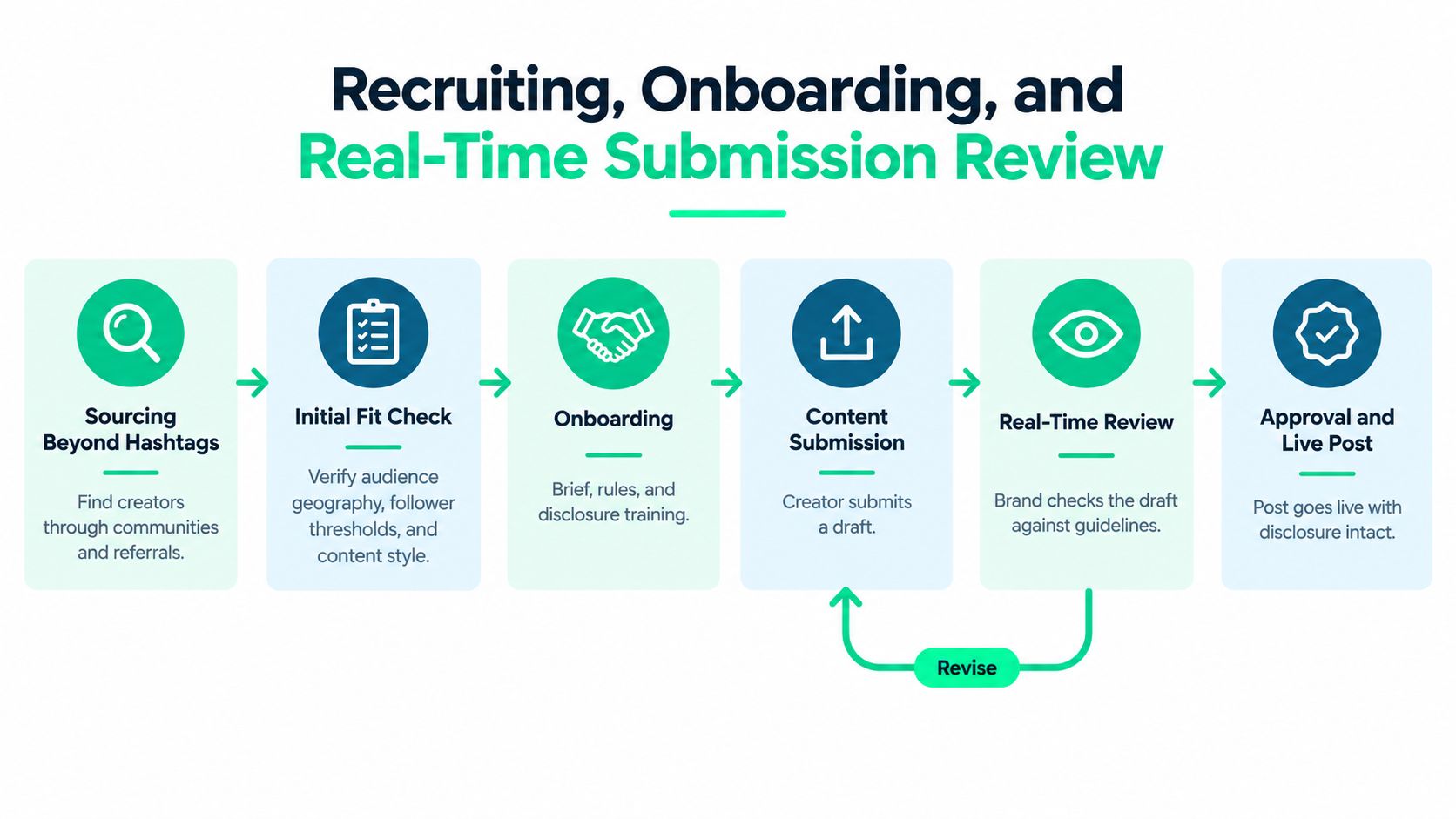
Recruiting starts with communities, referrals, prior gifting performers, and creators whose audience already matches the brand's buyer. Hashtag scraping gives you noise. It does not give you a roster you can run.
Keep the onboarding path short and enforceable
Fit comes first. Check audience geography, content history, and whether the creator already posts in the category you care about. Then keep the written agreement short enough to get signed quickly.
Onboarding should train the creator on disclosure, caption rules, visual rules, and what cannot appear in the post. The agreement should also give the brand review rights and the ability to pause or remove noncompliant content, because a live page is not the place to negotiate.
A rules engine with an AI pre-screen and a human approval layer is what lets a team handle heavy submission volume without more reviewers. That setup keeps control over tone, claims, and disclosure placement. If you are building the operational logic, AI scoring system is the right place to anchor the workflow.
The review queue should be boring on purpose. A draft comes in, the system scores it, a human checks the edge cases, and only then does it go live. Missing disclosure, hidden disclosure, or disclosure that is too easy to miss gets a hard no.
Use a review loop, not a publish-and-pray process
A good queue stops bad posts before they ship. A stronger queue also gives creators a fast revision path, so the team does not lose the relationship over a fixable issue.
- Sourcing: Pull candidates from niche community moderators, prior gifting performers, and referral lists from existing ambassadors.
- Fit check: Verify geography, follower thresholds, and content style.
- Onboard: Send the brief, rules, and disclosure training.
- Submit: Creator uploads a draft.
- Review: Check the draft against the program rules in real time.
- Approve or revise: Publish only after the disclosure and content pass review.
A network-wide caption update should reach every page in minutes, not weeks. That only happens when the caption library, approval workflow, and posting rules all live in one place.
Brand Safety and US Audience Verification as a System, Not a Checkbox
Brand safety is the program. If the page is unsafe, or the audience is not the U.S. market you paid for, the rest of the workflow is theater.
A strong ambassador roster starts with controls at the point of submission. The review step should check disclosure, page quality, and audience location before a post gets approved. If you are setting that up, AI scoring system is the right place to anchor the workflow.
Disclosure has to be visible, not buried
In the United States, the FTC requires influencers to clearly disclose a material connection with a brand, including payment, free or discounted products, employment, family relationships, or other financial arrangements. The disclosure has to be clear enough that viewers understand the relationship when they see the endorsement, and responsibility sits with both the creator and the sponsoring brand. (FTC disclosures for social media influencers)
Placement matters. A disclosure that sits at the bottom of a long caption, or disappears into hashtags, does not do the job. Every paid or incentivized submission needs a disclosure check before it goes live, with captions, on-screen text, and any other creative element reviewed in context. For the execution side, keep sponsored content rules close when you build the review workflow.
If the brand cannot see the disclosure, the post does not ship.
High-quality U.S. views need traffic controls
Audience quality deserves the same attention as compliance. Reported impressions can be gamed, and a large distribution program should not count views blindly. CHEQ's 2023 report estimated that overtly malicious traffic made up 17.4% of the fake traffic it blocked in 2022 and 2% of all examined traffic, while traffic trying to reach advertising and marketing websites represented 7.9% of total site traffic in the report's analysis. (CHEQ fake traffic report)
That does not mean every creator is fraudulent. It means the roster needs controls.
- Geo filters: Keep the focus on tier-1 U.S. audiences.
- Abnormal-activity screening: Flag sudden spikes and suspicious patterns.
- Account exclusions: Remove pages that do not meet quality rules.
- Post-level monitoring: Count verified views only after the post clears review.
The operating rule is simple. If you want to scale into billions of views without losing control, every submission needs to pass real-time review, and every audience claim needs verification before the view is counted.
Tracking Performance and Preventing Ambassador Roster Fatigue
Brands that keep adding ambassadors because the list looks longer end up with a roster hygiene problem. The program looks busy on paper and dead in practice.
Track activity first. A creator who posts once and disappears does not help a small-influencer program. Neither does a large roster where nobody is posting, nobody is replying, and nobody is driving repeat value.
Use activation rate, repeat-post rate, response time, content quality, audience fit, and incremental outcomes by cohort as the core signals. Those measures show whether the roster is active or just padded.
| Primary Goal | Top Metrics to Track | Signal of Roster Fatigue | Action Trigger |
|---|---|---|---|
| Awareness | Activation rate, repeat-post rate, verified U.S. views | Many signups, few live posts | Re-onboard or prune inactive creators |
| Sales | Unique code redemptions, attribution-window conversions, repeat-post rate | Codes shared once, then silence | Shift spend to creators with repeat activity |
| Community | Response time, content quality, audience fit | Slow replies and generic content | Tighten briefs and refresh the cohort |
| Testing | Cohort-level incremental outcomes, activation rate | Small tests that never repeat | Cut low-signal segments and expand winners |
The six signals that show a roster is alive
A healthy roster leaves a trail. Creators reply quickly, post again, and keep the content aligned with the brief. Weak rosters look different. They stall, drift, and burn time for the team managing them.
Set a clear inactivity policy and use it without sentimentality.
- Re-onboard periodically: Reset expectations and rules for active creators.
- Keep deliverables flexible: Let the strongest performers use formats their audience responds to.
- Pay on time: Slow payment kills momentum fast.
- Give fast feedback: Creators improve when they know what to fix.
- Remove inactive accounts: Make room for creators who still want the work.
The payout method should match the signal. Verified U.S. views fit reach-focused campaigns, unique promo code redemptions fit clean conversion tracking, and attribution-window conversions fit longer sales cycles. One metric should not be forced to do every job.
Roster fatigue shows up early if you watch for it. Dead accounts, slow replies, one-and-done posts, and generic content are the warning signs. Cut them before they spread through the program.
Scaling a Small-Influencer Program From Pilot to Billion-View Reach

A growth marketer starts with ten creators. The first version is narrow, U.S.-only, and heavily supervised. Every caption gets checked, every disclosure is standardized, and the team watches which handles produce verified attention.
What changes at each stage
At the pilot stage, the rules are simple. Filter for U.S. geography, use one disclosure template, and keep the content brief tight enough that review is fast. The goal at pilot stage is proof that the creators, the audience, and the content format fit.
At the next stage, the brand adds vertical targeting. Sports, gaming, and finance audiences get their own rules, exclusions, and tone requirements, because a page that works in one niche can be wrong in another. Caption edits happen in real time, so the team can update a line once and push it across the roster instead of chasing each creator separately.
As the program matures, reporting gets consolidated. The marketer can see which handles drive verified views, remove off-brand pages in one click, and shift attention toward the cohorts that perform. The roster stops being a list and becomes routing infrastructure.
The scaling move is removing manual creator work from the operating model, not hiring more people.
That is how one marketer runs a network that behaves like a much larger media machine. The team still sets the rules, but the system handles recruiting, review, measurement, and removal in one place.
Ambassador programs for small influencers are a programmable distribution layer built for American audiences, brand safety, and repeatable reach.
If you want a tighter operating stack for creator distribution, visit FindClout and see how it handles verified views, real-time review, and audience filtering for U.S.-focused campaigns. If your ambassador roster still lives in DMs and spreadsheets, bring it into FindClout's review and distribution workflow and run your next pilot on verified U.S. views.
Want this audience for your brand?
FindClout puts your brand in front of verified American audiences across every major US page — brand-safe, at scale.
Start Your Campaign