 findclout.com
Alternative to Facebook Ads: Channels Compared for 2026
YouTube's potential global advertising audience exceeded 2.53 billion people at the beginning of 2025, compared with Facebook's 2.28 billion, according to DataReportal's platform comparison. An alternative to Facebook Ads doesn't have to mean accepting smaller reach. The harder question is whether another channel can deliver incremental American customers, not merely cheaper impressions or more attributed conversions.
For U.S.-focused advertisers, the decision should start with audience geography, purchase intent, and brand safety. Compare acquisition economics only after those conditions match. Otherwise, you're comparing different products under the same advertising label.
Table of Contents
- Facebook Ads Alternatives Compared on Cost, Audience and Measurement
- Why Budgets Are Moving Beyond Facebook
- Judging Creator Attention Beyond CPM
- Paid Search and TikTok Compared on Intent and Discovery
- Brand Safety and Disclosure Controls for U.S. Campaigns
- Pick Your Channel Mix Before Cutting Facebook Spend
- How to Move Budget Off Facebook in Six Steps
Facebook Ads Alternatives Compared on Cost, Audience and Measurement
No single channel replaces Facebook for every objective. Shortlist two alternatives that fit your audience and commercial goal, then test them against your own Facebook acquisition economics.
The comparison below separates the price of distribution from the price of an additional customer. Cost per incremental customer isn't available from a platform benchmark, because it requires your own controlled test.
Facebook alternatives compared on cost, audience, measurement and trade-off
| Channel | Cost benchmark | Best-fit audience | Measurement strength | Main trade-off |
|---|---|---|---|---|
| Google Search | $5.26 CPC; $70.11 cost per lead in WordStream's U.S. campaign benchmark. Incremental customer cost requires a holdout. | Users already searching for a need | Conversion tracking and imported qualified-lead or purchase events | Strong intent but high click cost |
| TikTok Ads | $13.26 median CPM in an ecommerce panel; $6.21 CPM in a U.S.-focused tracker, reported in Whatagraph's benchmark comparison. Incremental customer cost requires testing. | Younger audiences reached through short-form video | Platform-reported conversions, with click-through and view-through separated | Frequent creative iteration; benchmark populations differ |
| Creator and meme distribution (FindClout) | $0.20 CPM for logo campaigns; $0.25 CPM for vertical campaigns; $1.50 to $3.00 CPM for content campaigns. Incremental customer cost measured separately. | U.S. sports, gaming, finance, crypto, and fintech audiences | Verified-view billing with live creator analytics | Persistent, shareable placements; disclosure controls required |
| Snapchat Ads | Obtain a campaign-specific CPM quote; incremental customer cost unestablished | Audiences suited to mobile-first visual creative | Instrument app or purchase events and validate against a control | Requires its own creative and audience test |
| Connected TV | Obtain a publisher or buying-platform quote; incremental customer cost unestablished | Living-room video reach | Matched-market lift and downstream conversion analysis | Less direct click-based feedback |
| Native ads | Obtain placement-specific pricing; incremental customer cost unestablished | Readers encountering placements within editorial feeds | Tagged visits, qualified conversions, and holdouts | Commercial nature must remain clear |
| Facebook Ads baseline | Use your actual CPM and customer acquisition cost | Broad-interest and retargeting audiences | Pixel and modeled conversions, checked against business records | Your own acquisition economics are the benchmark to beat |
Read the cost columns correctly
CPM, CPC, and cost per lead measure different outcomes. CPM prices exposure, CPC prices a visit, and cost per lead prices an action that might never become revenue. None establishes whether the advertiser acquired someone who wouldn't otherwise have purchased.
Calculate cost per incremental customer by dividing the additional campaign cost by the additional new customers attributable to the test. Include production and distribution costs consistently across channels. If a campaign produces no credible additional customers, a low CPM doesn't rescue its economics.
The TikTok benchmarks also illustrate why geography matters. Don't treat an ecommerce panel and a U.S.-focused tracker as interchangeable, and don't compare either with creator distribution unless delivery geography, exposure windows, and conversion definitions match.
For the strategic distinction between query-led buying and audience-led buying, Come Together Media's analysis for CMOs, from Come Together Media LLC, provides useful context. Use that distinction to choose a test, not to declare a universal winner.
Why Budgets Are Moving Beyond Facebook
Say an American consumer-app marketer keeps increasing Facebook spend but sees little improvement in new-customer volume. The next move shouldn't automatically be another audience expansion. The marketer needs to establish whether the constraint is auction cost, repeated exposure to the same people, or weak access to a specialized community.
The broader market supports testing outside a single buying system. U.S. internet advertising revenue reached $258.6 billion in 2024, up 14.9%, while social advertising generated $88.8 billion, representing 34.3% of digital revenue and growing 36.7%, according to the IAB/PwC Internet Advertising Revenue Report.
Diversification isn't an exit strategy
Those totals describe advertiser spending, not proof that any particular alternative will outperform your account. A useful diversification test must answer a narrower commercial question.
- Auction exposure: Can another buying route acquire customers without increasing dependence on the same auction?
- Audience overlap: Does the alternative reach additional American prospects rather than repeatedly encountering existing customers?
- Community access: Can the creative fit the language and interests of a sports, gaming, or finance audience?
A marketer considering living-room video can use Adwave's discussion of TV advertising instead of Facebook ads to frame that option. The relevant comparison is the additional business generated, not whether television looks more established than social advertising.
Keep a productive channel until the replacement proves it can add profitable demand.
The decision is therefore not whether Facebook has become obsolete. It's which alternative addresses your current constraint, and how much exposure you can fund without disrupting the acquisition activity that already works.
Judging Creator Attention Beyond CPM
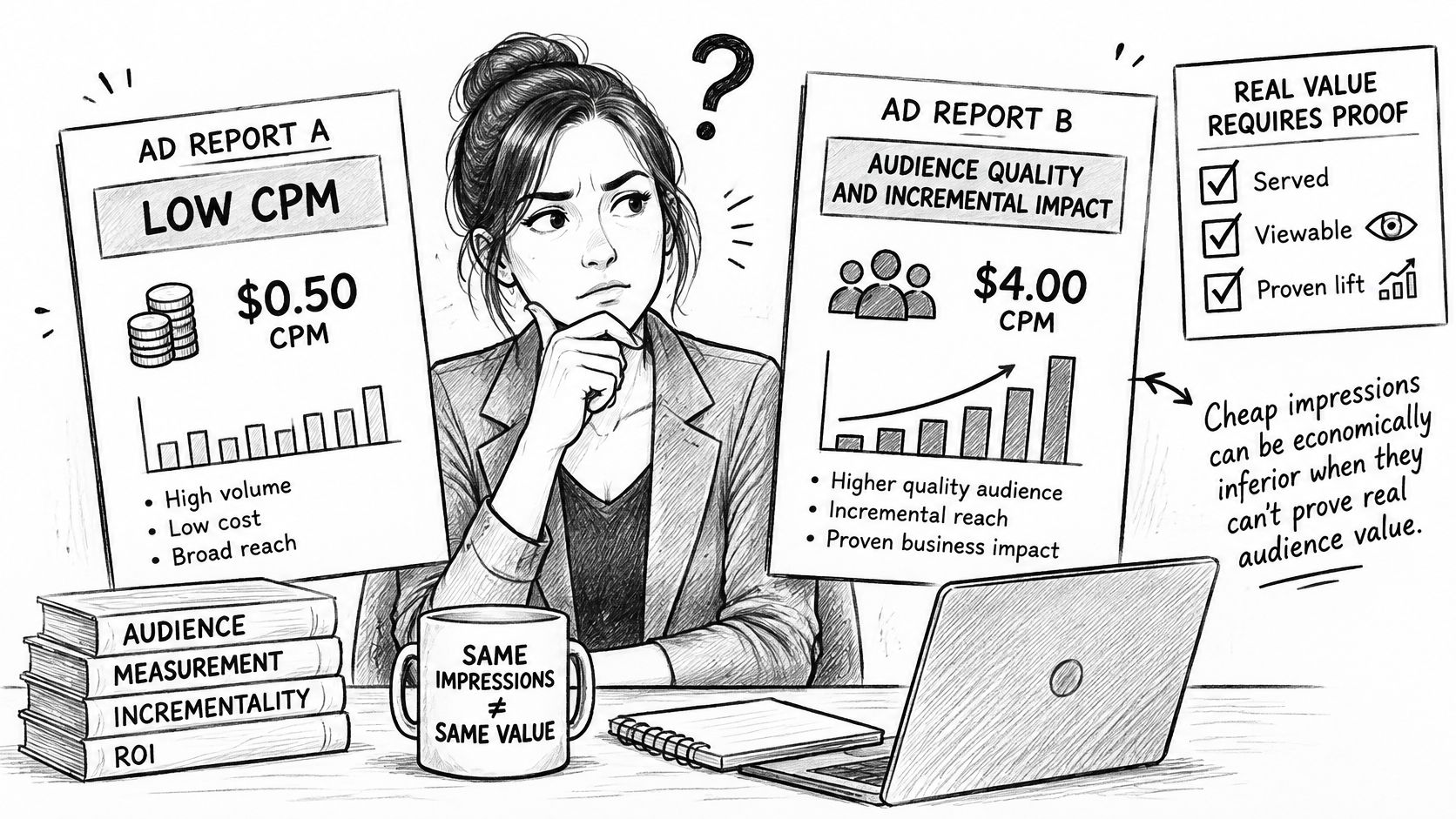
A low CPM can be economically inferior when the buyer can't establish audience quality or incremental impact. An inexpensive view from an unsuitable geography doesn't become valuable because the invoice is small.
Creator buying warrants serious measurement: U.S. creator-economy advertising spend reached $29.5 billion in 2024 and was projected to reach $37 billion in 2025, according to the IAB's creator advertising report. That projected growth isn't evidence of your campaign's effectiveness. It's a reason to apply the same financial discipline you'd apply to established channels.
Evaluate the relationship between inexpensive delivery and commercially useful attention.
Define the attention you're buying
Specify whether a reported view means a served impression, a viewable placement, completed viewing, or verified human attention. These aren't interchangeable, and the word “verified” needs an operational definition covering eligibility, geography, and invalid-traffic treatment.
At FindClout, we run native posts on 2,000 real pages. Creators apply and are approved per campaign, and each page is run by the people who built it. Applicants submit screenshots and screen recordings of audience-analytics dashboards, giving our review team evidence for assessing American audience fit rather than relying on an account's name or subject matter.
Separate exposure from additional demand
You don't need a custom attribution model to begin testing, but you do need a credible comparison.
- Geo holdouts: Match U.S. regions using prior customer activity, then introduce creator distribution only in the treatment regions. Compare changes, not raw sales totals.
- Creator-group tests: Organize participating pages into comparable groups and stagger activation. Account for overlapping audiences before treating those groups as independent.
- Post-view studies: Examine later purchases among eligible exposed audiences, with an appropriate unexposed comparison. A purchase after viewing isn't automatically a purchase caused by viewing.
Report brand-search lift, assisted conversions, direct traffic, and customer acquisition cost alongside delivery metrics. Treat the first three as supporting signals, not additional customers to add together.
Ask who operates each page behind the delivery, and document the answer before launch. Our campaign-level creator approval makes that accountability concrete.
Buying rule: Verified attention establishes what was delivered. Incrementality establishes whether it was worth buying.
A creator placement can contribute without winning the final click. It still needs to contribute something measurable beyond a large view count.
Paid Search and TikTok Compared on Intent and Discovery
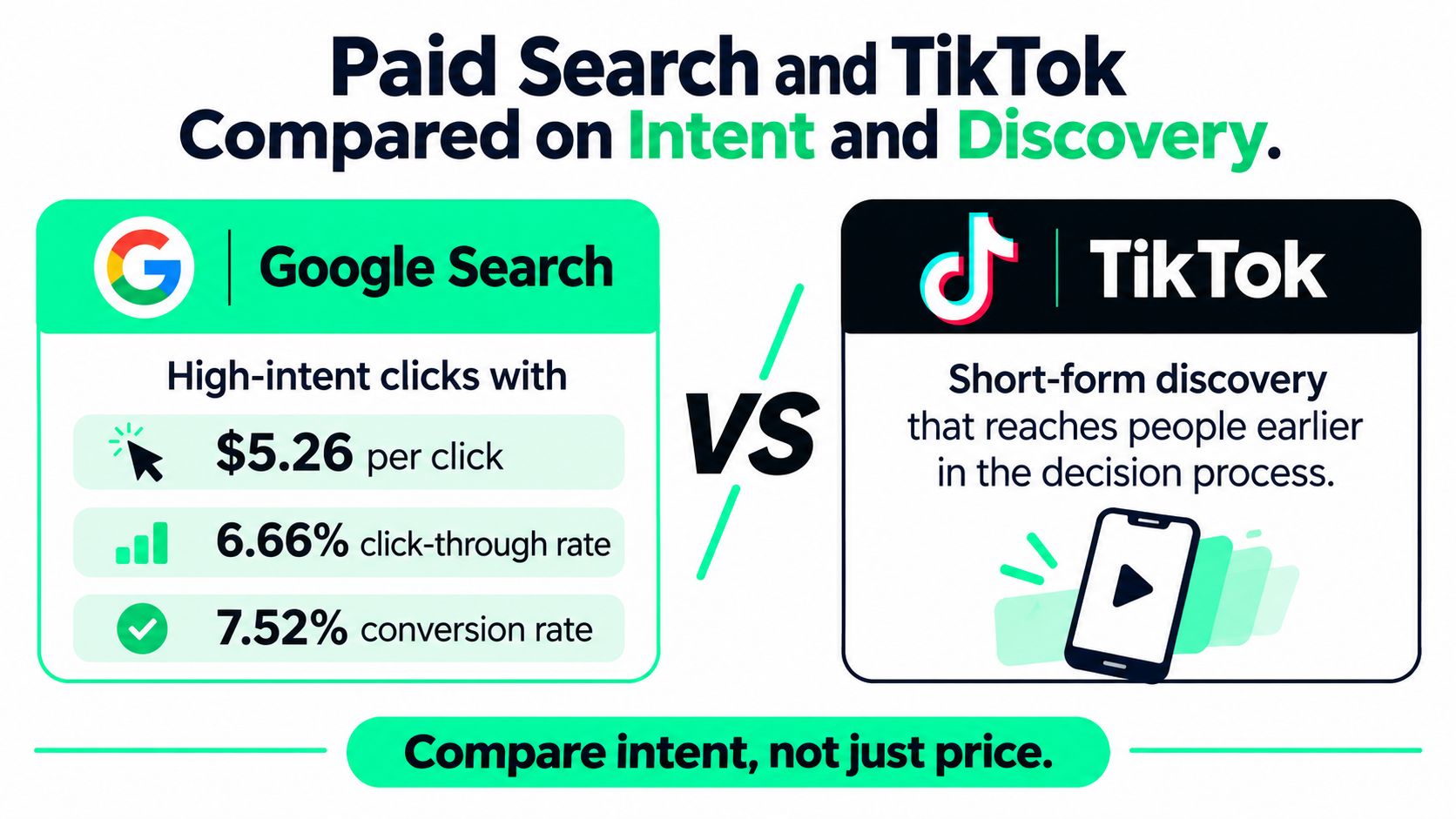
Search and short-form video solve different problems. Search captures expressed demand; TikTok and creator distribution can introduce an offer before someone searches for it. Comparing them only on click price can favor cheap curiosity over commercially useful intent.
Use the distinction below to decide what each channel must prove.
Build Search around business outcomes
Separate branded, category, competitor, and high-intent problem queries. Combining them can hide important differences: a branded searcher may already know your product, while someone describing a problem may still be choosing a solution.
Import qualified-lead or purchase events, rather than treating every form submission or landing-page action as equivalent. For an American fintech app, for example, an eligible activated customer is a more useful optimization event than an unqualified signup.
Maintain a search-term review process. Exclude irrelevant queries, distinguish existing-customer navigation from acquisition, and reconcile reported purchases with your transaction records. Otherwise, apparently efficient Search performance can reflect demand that other activity already created.
Give discovery a different assignment
TikTok's auction-delivered impressions require platform-native video testing. A search ad answers a query; a short-form video must first give someone a reason to care. Reusing the same message without adapting the format is not a clean channel comparison.
For a gaming app, test distinct motivations such as competition, entertainment, or a recognizable gameplay problem. Keep the downstream conversion event consistent, but let the opening hook reflect how people encounter the content.
Our analysis of native distribution versus Search Ads examines this budget decision through the roles each channel can play. The practical question is whether another dollar should capture existing demand or help introduce the product to additional prospects.
The accompanying video provides another format for considering the channel decision.
A discovery campaign may increase branded searches while Search receives the conversion credit. Don't solve that problem by assigning all later searches to discovery, either. Evaluate the combined acquisition system against a control, then use channel-level diagnostics to understand where customers entered and where they completed the purchase.
The useful conclusion is conditional: prioritize Search when qualified demand exists and remains economically accessible. Prioritize discovery testing when your constraint is getting suitable American prospects interested in the first place.
Brand Safety and Disclosure Controls for U.S. Campaigns
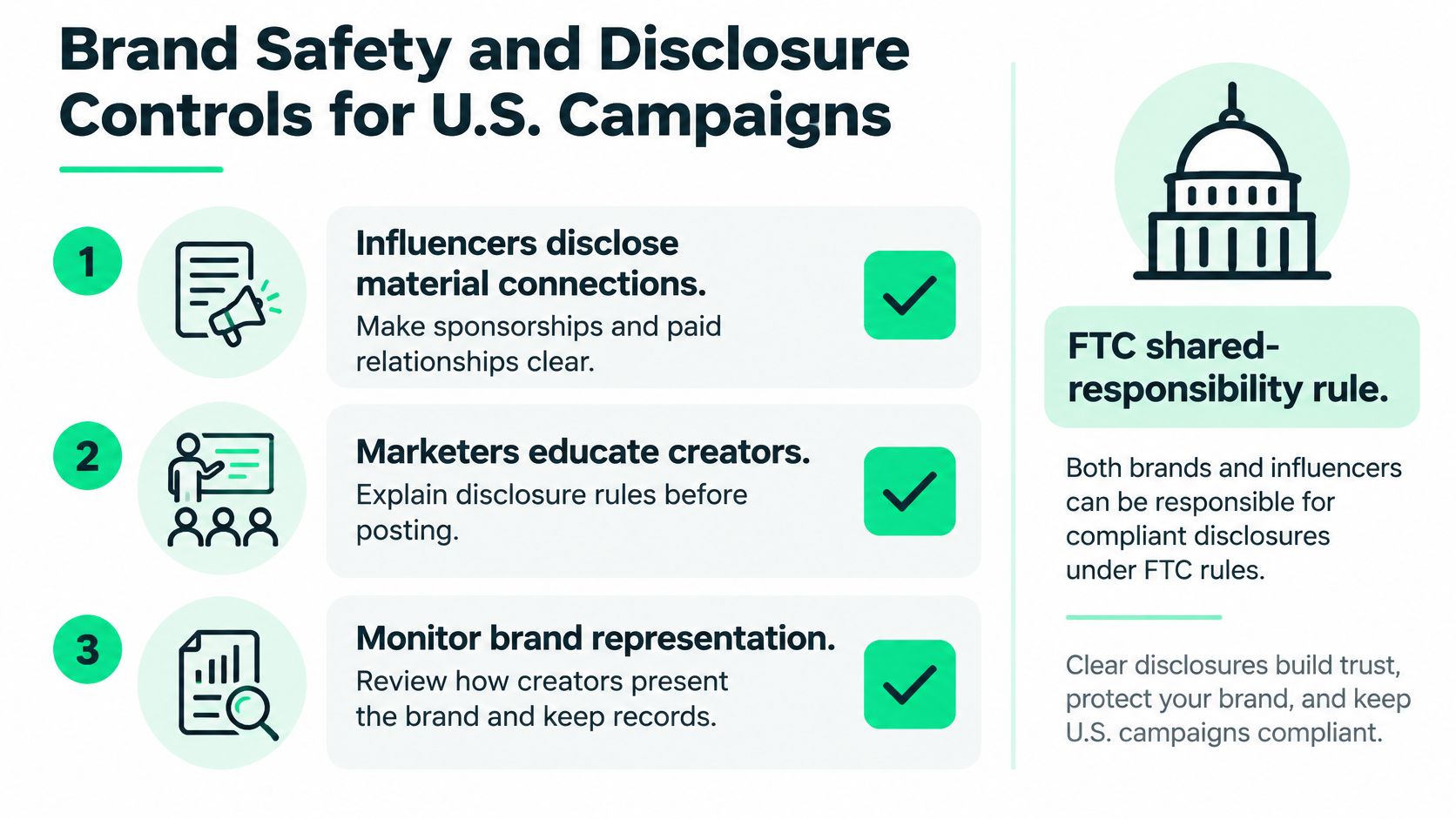
Influencers must disclose material connections, while marketers must educate them and monitor their brand representations, according to the FTC's influencer disclosure guidance. Monitoring is a compliance responsibility, not merely an optional reporting feature.
Posting from another country doesn't remove the issue: U.S. rules can apply when effects on U.S. consumers are reasonably foreseeable, and the disclosure must accompany the endorsement, explains the FTC's Disclosures 101 guide.
The shared responsibilities should be explicit before creators receive a campaign.
Treat disclosure as part of the creative
Meme advertising resembles ordinary entertainment, so commercial identification needs deliberate placement. The FTC's native advertising guidance calls for clear, prominent disclosures, unambiguous language, proximity to the advertisement, readable presentation, and sufficient on-screen time in video.
Don't approve the joke separately from the disclosure. Review the actual caption, watermark, crop, and video sequence that the audience will encounter.
Set operational controls before publication
- Approve every variation: Review captions, logos, and disclosures together so the commercial relationship remains apparent in the finished post.
- Screen prohibited topics: Prevent placements that conflict with the brand's restrictions or misrepresent its offer.
- Set follower thresholds: Establish page eligibility, while recognizing that follower count alone doesn't establish audience quality.
- Apply geography filters: Match delivery to the American or other specified tier-one audience being purchased.
- Exclude unsuitable pages: Block accounts whose surrounding content creates unacceptable reputational risk.
These operational controls support oversight; follower thresholds and geography filters aren't themselves FTC disclosure requirements. Our brand-safety guidelines explain the campaign controls that make review repeatable.
We combine automated scoring with human review before posting, and review submissions in real time against campaign rules. Centralized approvals, caption controls, fraud screening, and audience vetting are the systems needed to pursue billions of views without abandoning brand protection or high-quality geographies.
Brands can remove a post or creator from their campaign dashboard in one click. Assign a named owner to every approval, monitoring, and removal responsibility before the first post goes live.
Pick Your Channel Mix Before Cutting Facebook Spend
If Facebook still acquires profitable American customers, keep it running while testing the gap in your current mix. Replacing a functioning campaign because another channel advertises cheaper delivery confuses buying price with business value.
Choose the lead channel according to the immediate constraint. A company with qualified search demand needs a different allocation from an unfamiliar consumer app that first needs people to understand its appeal.
Recommended channel mix by situation
| Situation | Lead channel | Supporting channel |
|---|---|---|
| High-value direct response | Google Search for new-customer demand capture | TikTok tests; Facebook kept for retargeting |
| Awareness or app installs, younger audiences | TikTok and creator distribution | Search for branded queries |
| Sports, gaming, finance, or crypto audiences | Creator networks scoped to the vertical | Search for competitor queries |
| Regulated or brand-sensitive category | Pre-approved creator distribution with exclusions | Native placements only after review |
For high-value direct response, prioritize the channel closest to a qualified purchasing decision, provided sufficient relevant search demand exists. Retargeting can remain useful, but assess whether it reaches undecided prospects or mainly claims people already returning to purchase.
For awareness and app acquisition, evaluate the quality of the users after installation. A low install cost won't compensate for users who never activate, aren't geographically eligible, or don't return.
Make audience quality a buying condition
Vertical creator distribution is most relevant when audience context helps explain the offer. Sports content may provide a useful setting for a sports-related product, but interest in sports doesn't establish eligibility for betting or other restricted products. Apply product-specific legal and platform requirements separately.
For regulated or reputation-sensitive advertisers, rank pre-approval, exclusions, and removal controls ahead of the cheapest available CPM. A placement that cannot pass review shouldn't enter the economic comparison.
Don't allocate budget to a channel until you can name the customer it should add and the evidence that would justify more spend.
Set the initial test budget from your acceptable learning loss and the customer volume needed for a meaningful comparison. Avoid presenting an arbitrary percentage as a universal allocation rule.
This week, shortlist two channels, freeze the definitions in your Facebook baseline, and schedule a test with an explicit decision date. Decide in advance whether success means additional qualified customers, improved contribution margin, or access to an otherwise difficult-to-reach American audience. Those outcomes can inform the same decision, but they shouldn't be substituted for one another after results arrive.
How to Move Budget Off Facebook in Six Steps
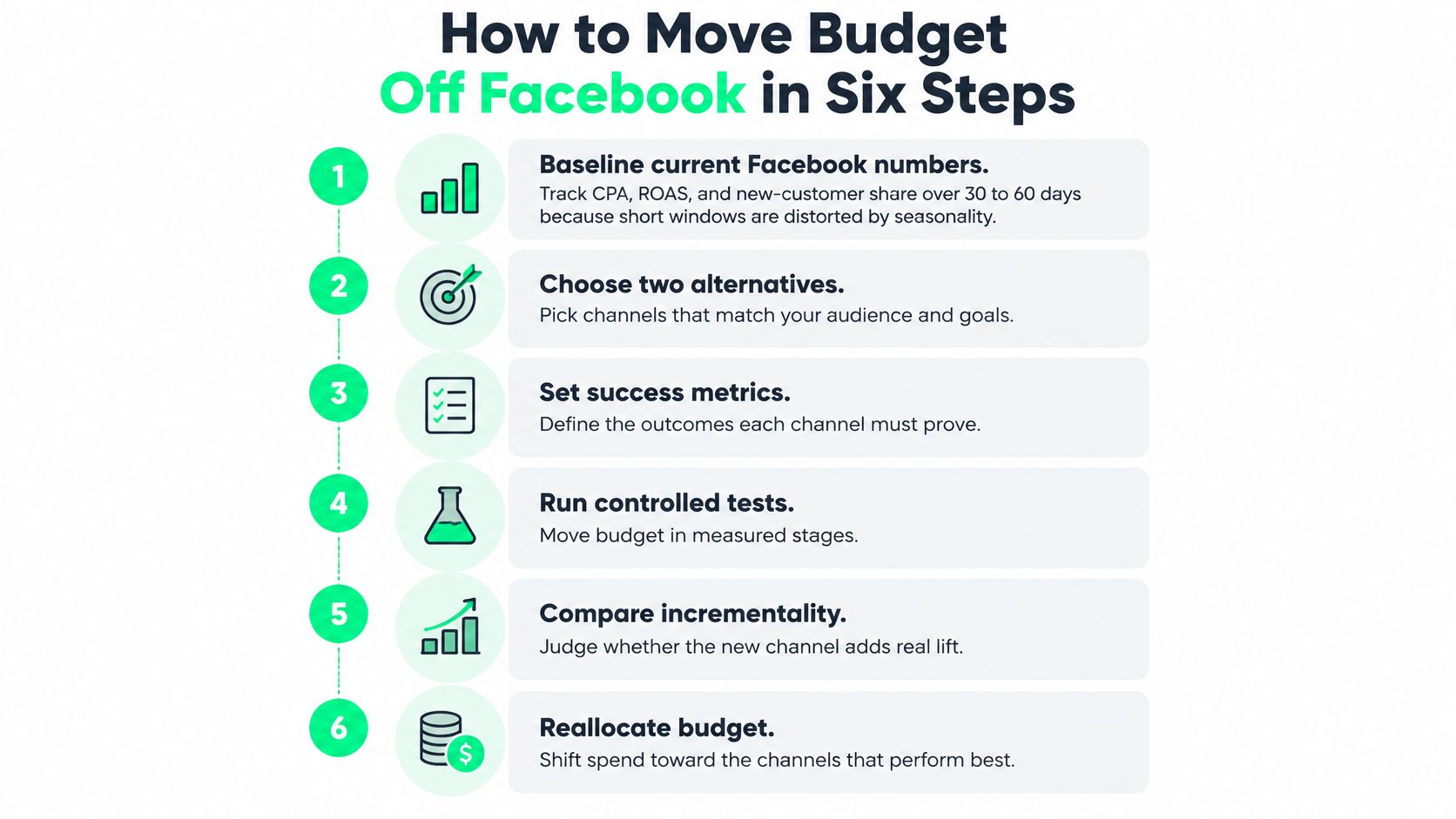
A useful migration plan specifies what stays fixed, what changes, and who can authorize more spending. Keep a written test log so creative edits, targeting changes, and delivery interruptions don't disappear into a blended performance report.
Use this process to organize the transition.
Prepare the comparison
Baseline current Facebook numbers. Export spend, CPA, ROAS, and new-customer share, using a period that covers your normal purchase cycle and relevant trading conditions. Reconcile customer status with your CRM or order system. Common slip: treating a promotional spike as normal acquisition performance.
Choose two alternatives with distinct jobs. Pair a channel that addresses your actual constraint with another plausible route to the same qualified audience. For example, compare category Search with vertical creator distribution when you need to distinguish existing intent from demand creation. Avoid: choosing both channels solely because their delivery prices look low.
Fund a controlled test. Reserve an untreated region or eligible audience, and document the outcome that would justify expansion. Keep enough budget on established activity to avoid confusing a disrupted baseline with an alternative's contribution. Watch for: comparing U.S. acquisition against cheaper international delivery.
Launch with controls and decision rules
Build a genuine creative comparison. Test different ideas and motivations, not merely cosmetic variations of the same post. Keep a record of concepts, hooks, publication times, and approved captions so you can identify what changed. Common slip: making a channel-level decision from a single creative execution.
Lock the operating rules. Record geography, page exclusions, prohibited topics, disclosure treatment, and the conversion event before launch. Assign escalation and removal owners, and verify that reporting can separate eligible American delivery from other traffic. Avoid: accepting aggregate views when the commercial agreement requires a particular audience.
Reallocate only after a credible review. Schedule operational checks early, but allow the purchase cycle and reporting delay to mature before judging acquisition outcomes. Expand when the treatment produces credible incremental value at acceptable economics, not merely when a platform dashboard reports attractive attribution.
Use a reporting sheet that includes CPM, cost per qualified visitor, CPA, frequency, and incremental lift, with consistent geography and exposure windows. Add notes for refunds, disqualified leads, and customer eligibility where those change the commercial result.
Our guide to allocating a marketing budget can help translate the test into spending decisions. The first successful review should establish whether the alternative added useful demand, explain the uncertainty, and identify the next controlled change.
FindClout offers verified-view creator distribution with American audience vetting, campaign-level approvals, and real-time brand controls. Visit FindClout to discuss a sports, gaming, finance, or consumer-app campaign that can be evaluated alongside your Facebook baseline on audience quality and incremental customer acquisition.
Want this audience for your brand?
FindClout puts your brand in front of verified American audiences across every major US page — brand-safe, at scale.
Start Your Campaign