 findclout.com
How to Add Meme Text That Actually Goes Viral
“Use white Impact in all caps” is the most repeated advice for adding meme text, and it's also where many campaigns stop thinking. A caption isn't decoration. It's a performance variable that has to survive a thumb-stop, a crop, a brand-safety screen, and the humor norms of a specific audience.
A caption that looks fine on a desktop preview can become unreadable on a six-inch phone. A clean joke can contain a regional reference that an automated reviewer flags. A post can attract attention from the wrong geography or low-quality accounts and make reported reach look healthier than verified attention really is. For Tier 1 American audiences, especially in sports, gaming, finance, crypto, prediction markets, and iGaming, caption engineering and distribution controls have to ship together.
Table of Contents
- Why Most Meme Captions Fail Before They Ship
- The Right Way to Place and Size Meme Text
- Matching Caption Style to Audience and Niche
- Building a Brand-Safe Review Gate for Captions
- Choosing Between Native Editors, Web Tools, and Programmatic Distribution
- A Real Caption Workflow for Tier-1 Sports Audiences
- The Final Caption Checklist Before You Hit Publish
Why Most Meme Captions Fail Before They Ship
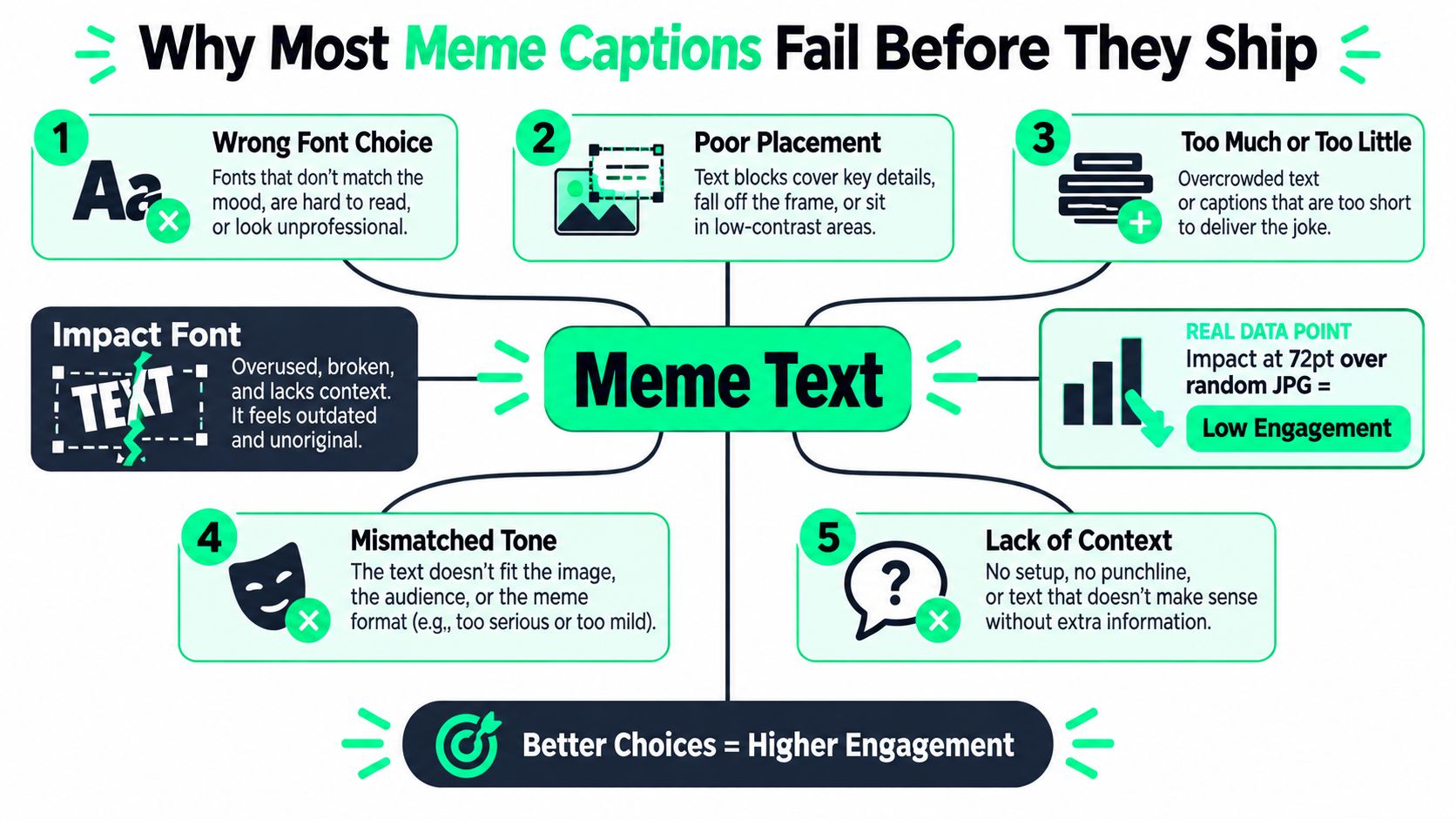
The default meme recipe is familiar: white Impact, all caps, thick black outline, text slapped across the top of a random JPG. It works often enough to remain recognizable, but recognition isn't the same as readability or shareability. A fixed 72pt Impact treatment over an unplanned JPG can collide with a busy background, wrap at the wrong point, or disappear when a platform crops the asset.
The layout also matters. Hard left or right alignment can push the visual joke away from the thumb-stop area, while a caption placed too close to interface controls gets covered or ignored. The text must be readable when the image is viewed quickly and at a tighter crop, not merely when the designer inspects the original canvas.
Shipping rule: Treat every caption as a distribution-ready asset, not as a final decorative layer.
A clean joke can still fail review. Sarcasm, slang, referee references, political language, active incidents, and culturally specific expressions can be interpreted differently by automated filters or by viewers in different regions. Poorly adapted memes can also trigger backlash and damage brand reputation, which is why independent research on meme marketing and social-media fraud supports combining content-based and behavioral screening rather than trusting a single signal.
Three constraints should govern the caption before it enters production:
- Legibility: It should remain clear inside a 1.5x crop on a six-inch screen.
- Safety: It should pass automated checks and have a defined path for human escalation.
- Audience fit: Its wording, rhythm, and cultural reference should match the intended Tier 1 American niche.
A 2024 study found that meme exposure produced stronger brand-name recall than traditional advertising, 62.0% versus 54.9%, but purchase behavior told a different story, with 29.6% reporting a purchase after meme exposure and 76.1% sharing at least one branded meme. The study's practical framework covers trend identification, audience alignment, brand integration, and performance analytics, so engagement shouldn't be treated as a substitute for downstream measurement. See this guide to improving headline CTR for a useful parallel: wording and placement need testing, not assumptions.
The Right Way to Place and Size Meme Text
Start with the canvas, not the font. For static memes, Impact or Anton is a reliable baseline because the letterforms hold up at small sizes. Use a 3 to 4px black stroke and a 1 to 2px white inner stroke when the background is visually complicated. The outline should separate the words from the image without turning the caption into a sticker.
For lifestyle content, Montserrat Black or another heavy sans-serif can feel less forced than Impact. That choice matters when the brand wants the meme to look native to the page rather than like a recycled template. Keep tracking tight, avoid decorative fonts, and break lines around the punchline instead of allowing the software to wrap them automatically.
Build around platform safe zones
For a 1080x1080 Instagram square, keep top and bottom captions inside a 960px safe band. For 1080x1920 TikTok, leave the bottom 250px and top 150px clear for interface overlays. For 1080x1350 Facebook, anchor text 80 to 120px from the edge so it doesn't feel cramped or get clipped in previews.
| Platform | Canvas size | Caption font size | Stroke width | Safe zone |
|---|---|---|---|---|
| Instagram square | 1080x1080 | 72 to 96px | 3 to 4px | 960px central band |
| TikTok vertical | 1080x1920 | 64 to 88px | 3 to 4px | Top 150px and bottom 250px clear |
| Facebook portrait | 1080x1350 | 70 to 94px | 3 to 4px | 80 to 120px from edges |
These font ranges are production starting points, not universal rules. Preview every export on a phone, test the image with the platform's actual interface visible, and check the first frame of video before approving the caption. For video workflows, a practical guide to captions on Instagram Stories is useful for thinking about overlay placement and interface collision.
Keep the reading load low
Aim for 5 to 7 words per line in a standard reaction meme. One short setup followed by a sharper second line usually reads faster than a paragraph compressed into uppercase. Use uppercase for emphasis, not for every word by reflex. A period can make a finance meme feel dry and intentional, while an exclamation mark often makes the same caption feel like an ad.
Keep logo placement subordinate to the joke. A logo placement guide can help establish consistent positioning without placing the mark directly over the visual reaction or the caption's highest-contrast area.
Matching Caption Style to Audience and Niche
The right caption length depends on what the audience already understands. Sports and gaming communities often recognize the context before reading the words, so a dry line such as “VAR found a reason” can work better than an explanation. Lifestyle and finance pages may need more setup because the joke depends on a situation, a contradiction, or a shared frustration.
An AI-versus-human meme study found that work-related captions scored better for humor and shareability than food or sports captions, which is a useful warning against treating every niche as interchangeable. The evidence doesn't justify a universal winning length, but it does show that topic and format change performance. Caption selection should therefore begin with the audience's reference points, not with a favorite font.
Use a niche-specific starting range
For sports and gaming, test 4 to 8 words with a restrained register. The audience often rewards understatement, reaction, and timing. A caption that names the exact emotional turn, such as “He said it was an easy win,” gives the image room to deliver the punchline.
Lifestyle and finance content can tolerate a longer setup, sometimes 10 to 14 words before the final turn, when the audience needs context. Finance memes often lose energy when they rely on pure Impact-style shouting. A quieter Arial Black treatment with a sentence-ending period can make the joke feel observational rather than promotional.
Audience heuristic: If viewers can identify the situation without explanation, shorten the caption. If the humor depends on a specific contradiction, preserve enough setup for the turn.
AI can help generate variants, but it shouldn't decide the final voice in every niche. The same study found a notable humor gap in lifestyle material, which means drafts in that category need heavier human editing. Gaming captions under six words can be a useful test cell because the format keeps the joke close to the reaction, but the final choice still depends on the page's established tone.
Before writing, classify the audience by three questions:
- Does the viewer know the reference immediately?
- Does the page use irony, sincerity, slang, or deadpan delivery?
- Would a newcomer understand the post without damaging the insider feel?
Use the caption-writing guide for save-worthy posts when the caption needs to carry more context than a reaction image can provide. The aim isn't maximum cleverness. It's a line that feels native enough to share and clear enough to measure.
Building a Brand-Safe Review Gate for Captions
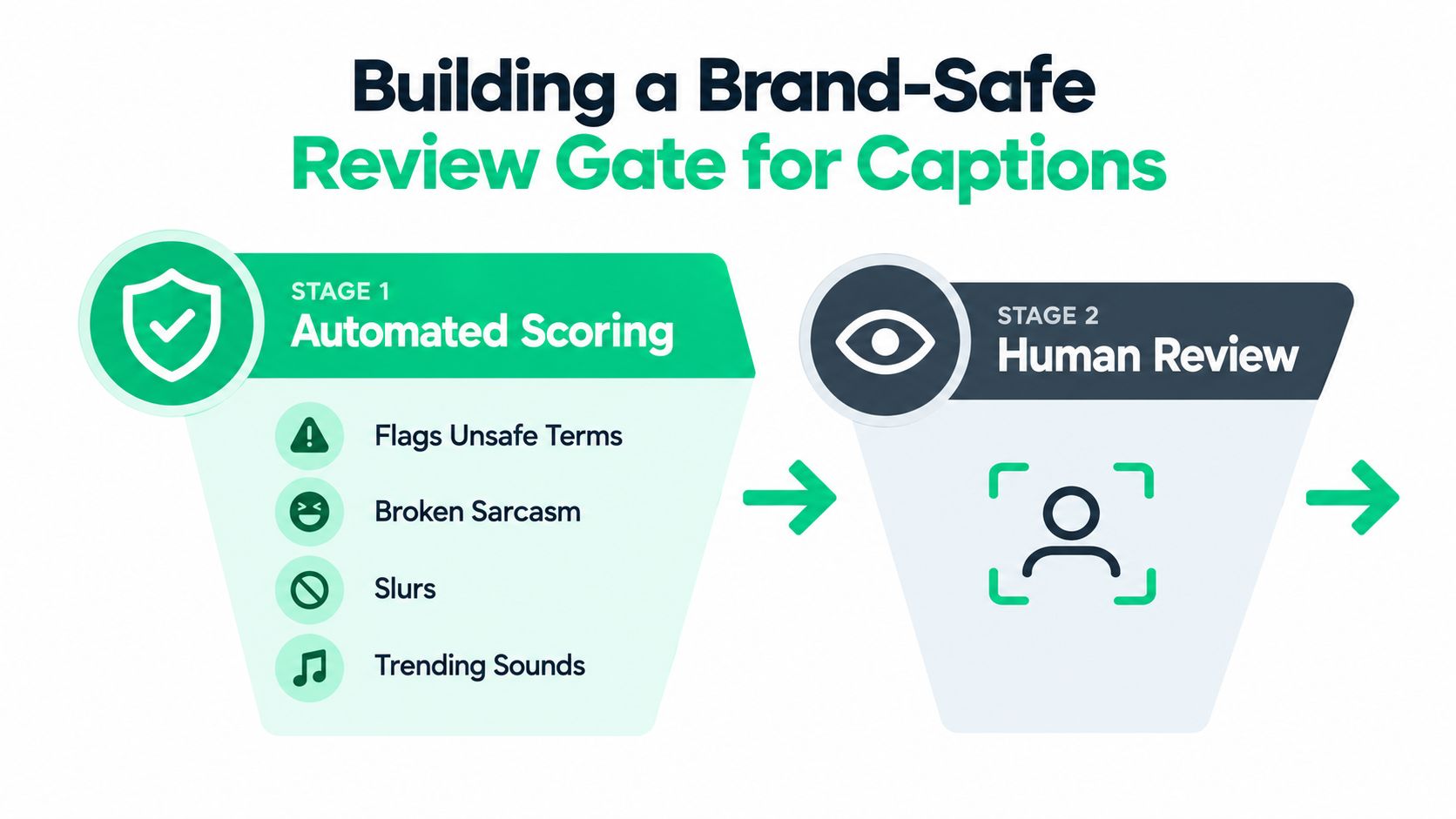
A meme caption should pass through the same discipline as paid ad copy. The workflow I use for scaled distribution has two stages: automated screening first, then human review for anything that depends on context.
Stage one screens for obvious risk
The automated layer should flag unsafe terms, broken sarcasm, slurs, references tied to active incidents, and trending sounds or phrases that have changed meaning. It should also check required terms, prohibited topics, geography rules, and audience exclusions before the post enters the publishing queue.
Real-time review is important because a slow approval process creates pressure to bypass the gate. Brand-safety systems described by HUMAN Security use explainable AI and real-time classification to provide an outcome that operators can inspect. A related industry discussion describes ad creative and surrounding content being evaluated in milliseconds, with trained reviewers handling satire, cultural nuance, and borderline visuals through escalation paths.
Stage two handles what classifiers miss
Human reviewers should inspect satire, regional expressions, inside references, ambiguous images, and captions whose automated confidence falls below the publishing threshold. Reviewers need a reason code, not a simple approve or reject button. Record the rationale, reviewer identity, caption version, and final decision so the team can trace what shipped.
A practical gate looks like this:
- Automated score: Scan wording, image context, sound context, creator history, and required exclusions.
- Confidence decision: Auto-clear only when the result exceeds the defined Tier 1 threshold.
- Human escalation: Route satire, cultural nuance, and uncertain references to a trained reviewer.
- Quarantine: Keep rejected or unresolved captions out of automatic retries.
- Distribution lock: Prevent any failed asset from reaching the publishing endpoint.
- Audit trail: Store the approved caption, variant lineage, reviewer rationale, and destination.
The review gate must extend beyond text. Fake engagement and fraudulent profiles can distort analytics and cause financial losses, so audience screening should combine content signals with behavioral signals. Suspicious spikes, inconsistent creator behavior, low-quality audience mix, and repeated anomalies deserve investigation before a campaign counts the attention as verified.
For teams formalizing handoffs, a documented content approval workflow helps connect creative review with publishing permissions. The central rule is simple: a caption can't be technically approved in one system and distributed through an endpoint that ignores the decision.
Choosing Between Native Editors, Web Tools, and Programmatic Distribution
There isn't one universally correct way to add meme text. The right lane depends on whether the campaign prioritizes native trend access, visual control, or scaled governance.
Native editors inside TikTok, Instagram Reels, and YouTube Shorts provide trending sounds, native effects, and a familiar publishing environment. They're strong for fast, reactive posts, but they limit font control, make batch rendering difficult, and keep the asset inside a platform-specific format.
Web meme generators and design suites offer better control over stroke, spacing, safe zones, templates, and asset reuse. They work well when a designer needs to produce a small family of variants and inspect each export. The trade-off is slower iteration and no native distribution signal.
Programmatic pipelines combine template rendering, caption generation, screening, audience rules, and API posting. They reduce manual repetition and can support large networks, but they require careful governance. A bad template or a weak rule can reproduce the same mistake across many posts, so automation only helps when the review gate is enforced before distribution.
| Lane | Control | Scale | Brand-safety fit | Best use |
|---|---|---|---|---|
| Native editor | Low to moderate | Limited | Manual review | Trend-led reactive posts |
| Web tool | High | Moderate | Strong preflight control | Precise assets and reusable templates |
| Programmatic pipeline | Template-dependent | High | Strong when gates are enforced | Multi-page distribution with audited rules |
Decision rule: Choose native when timing matters most, web tools when precision matters most, and programmatic distribution when scale must coexist with enforceable review.
AI can speed up first drafts, but generated copy still needs audience and safety checks. A practical AI caption generator guide is useful for understanding ideation workflows, while the final approval should remain tied to the brand's rules and the specific creator environment.
For brands buying verified attention from a curated network, FindClout is one programmatic option. It distributes branded meme content across vetted creator pages, supports brand-approved captions and watermarks, applies targeting and exclusion rules, and combines automated screening with human review before posting. That model fits teams that want one operational layer for caption control, audience vetting, and distribution rather than coordinating every page manually.
A Real Caption Workflow for Tier-1 Sports Audiences
Consider a regulated brand operating a sports meme page for a Tier 1 American audience. The team begins by pulling approved follower segments and refreshing exclusions for gambling-adjacent contexts and under-21 audiences. The goal isn't just to find a large audience. It's to make sure the audience and placement match the brand's rules before the creative gets scheduled.
The copy team drafts three captions against the same reaction template:
- “Ref saw something we didn't.”
- “That call needs its own documentary.”
- “The whistle had a different opinion.”
A satire-aware classifier checks the wording, regional expressions, referee references, creator environment, and audience filters. The first caption clears automatically. The second goes to human review because its tone could be read as an accusation in a sensitive context. The third is held because the surrounding trend reference has become ambiguous.
The borderline caption stays quarantined
The reviewer records why the second caption is acceptable, approves the first two only after checking the page context, and rejects the third rather than allowing an automatic retry. That decision protects the brand from treating a familiar sports joke as universally harmless. It also leaves an auditable record tied to the post and the specific caption version.
The cleared assets are exported for each platform's safe zones, scheduled through the distribution endpoint, and tagged for verified-view measurement. The team watches early audience quality, creator behavior, and variant-level downstream actions instead of treating likes or raw exposure as proof of purchase intent.
This workflow scales attention without surrendering control. It supports real-time review across a broad creator network, keeps high-quality geographies and Tier 1 American audiences in scope, and gives the brand a clear answer when someone asks why a caption shipped, changed, or was quarantined.
The Final Caption Checklist Before You Hit Publish
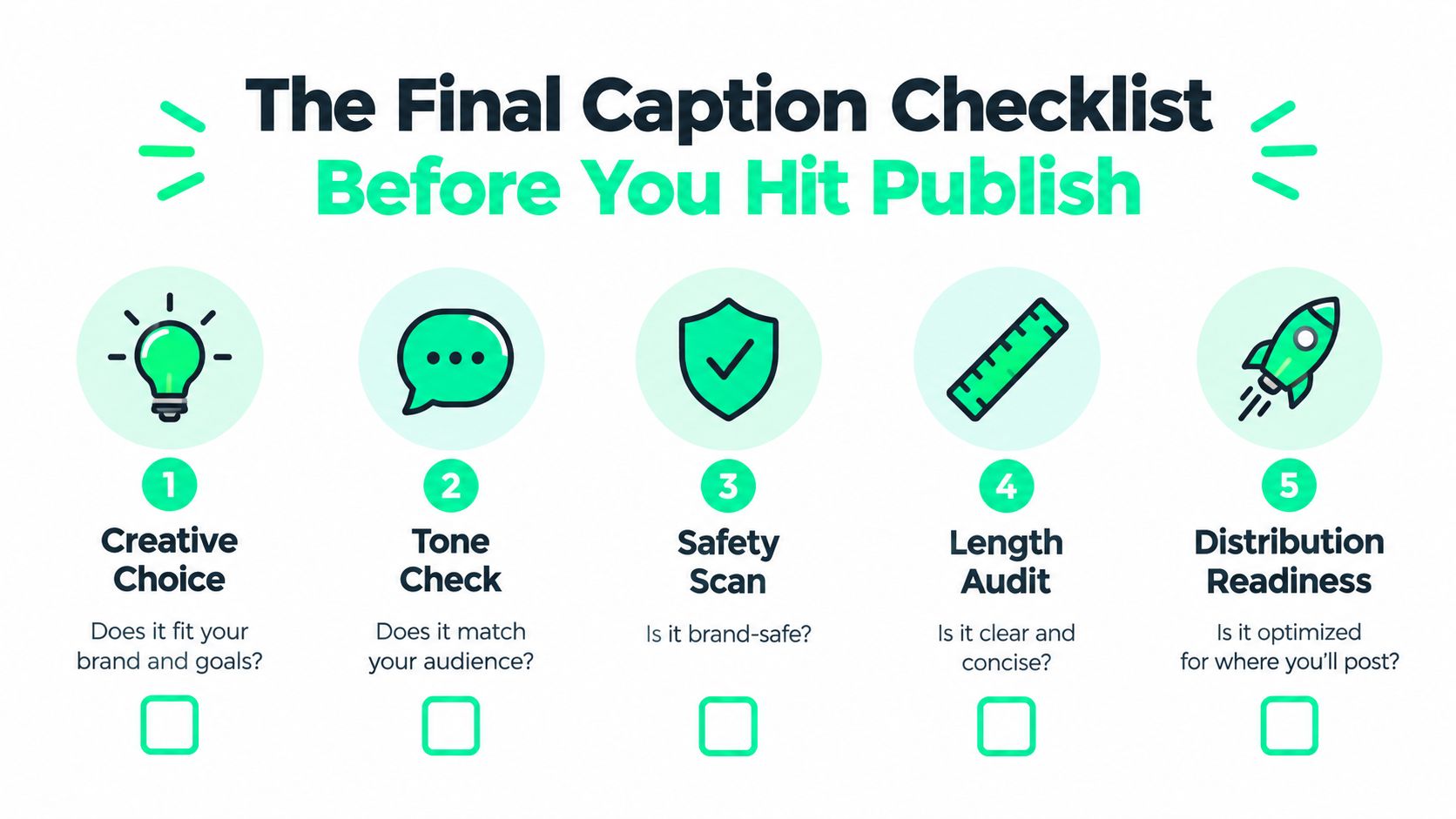
Run this checklist before every caption enters the queue. It should be fast enough for reactive content and strict enough for a paid placement.
- Creative choice: Does the image have a clear reaction point, and does the caption add a joke rather than explain the image?
- Font and stroke: Does the typeface suit the niche, and does the outline preserve contrast without overwhelming the visual?
- Safe zone: Is the text inside the platform-specific area, with overlays and interface controls accounted for?
- Tone check: Does the wording match the page's humor, audience vocabulary, and level of insider context?
- Length audit: Does the line break naturally, with enough setup for the niche and no unnecessary words?
- Safety scan: Has the caption passed automated screening for unsafe terms, slurs, broken sarcasm, active incidents, and prohibited topics?
- Human escalation: Has a reviewer checked satire, regional nuance, ambiguous references, and low-confidence results?
- Audience filter: Are excluded geographies, age groups, sensitive contexts, and unsuitable creator environments removed before queuing?
- Measurement tag: Is the post connected to viewability tracking, variant-level attribution, and the campaign's verified-attention reporting?
- Lineage log: Can the team identify the source template, caption version, reviewer decision, creator page, and final distribution status?
The last question is the one that catches most weak decisions: if this caption were attached to a $50 CPM buy, would it still ship? If the answer is no, it doesn't ship here either. Captioning is the QA gate between a funny idea and verified attention, not an afterthought added after the creative is already considered finished.
FindClout can help you distribute brand-approved meme captions across vetted creator pages while applying audience exclusions, brand rules, fraud screening, and real-time review. Visit FindClout to connect caption QA with Tier 1 American audience targeting and programmatic meme distribution.
Want this audience for your brand?
FindClout puts your brand in front of verified American audiences across every major US page — brand-safe, at scale.
Start Your Campaign